Art & Sports has quietly moved from a decorative sub-category to one of the more closely watched growth stories in contemporary collecting. This study examines why: the auction-house data, the institutional validation, the new collectors entering through sport and culture rather than the traditional gallery system, and the hospitality and wellness economy now treating movement-related art as a design imperative rather than an afterthought. It builds on ArtsBouquet's earlier historical studies of Art & Sports, and grounds its argument in the roster of painters and sculptors researched for this theme — from licensed sport portraiture to conceptual installation to gestural abstraction.
The wider art market gives this theme its first piece of context. Global art sales reached an estimated $59.6 billion in 2025, returning to growth after two difficult years, and high-net-worth collectors now allocate an average of 20% of their wealth to art — up from 15% in 2024. That expansion has not been evenly distributed: photography's dealer-market share doubled from 3% to 6%, prints and multiples rose to 12%, and buyers increasingly favour work that is conceptually legible and photographically or documentarily grounded — exactly the register much contemporary sport-related art occupies, from Andreas Gursky-style spectacle photography to Rineke Dijkstra-style athlete portraiture.
Sport-related art is riding this wider recovery rather than sitting outside it, but it is doing so from an unusually advantaged position: it has a foot in two expanding markets simultaneously — the traditional fine-art market described above, and the fast-growing collectibles and sports-memorabilia market, which auction houses now treat as a core, not peripheral, business line.
The clearest evidence that sport is being taken seriously as a collecting category comes from the auction houses themselves. Sotheby's entered the sports-memorabilia market in May 2020 with the sale of an early pair of Air Jordans, and has since built it into what the house itself describes as “one of the bigger luxury categories” it sells — culminating in a 2024 “Holy Grails” trading-card sale that brought in more than $7 million from bidders in twenty countries. Sotheby's has gone as far as positioning Michael Jordan memorabilia “next to Monet and Picasso” in its own marketing language.
What matters for ArtsBouquet is that this memorabilia boom is running in parallel with a genuine fine-art market for sport-related subject matter, and the two increasingly reinforce one another. Within the roster of artists researched for this theme, several data points illustrate the trajectory: AnnaPark's charcoal tennis drawings — closely cropped, physically tense studies ofcompetitive effort — now carry an auction record of $484,307 (Christie's HongKong, 2022) and gallery sale prices of $40,000–$58,000, following her move to Lehmann Maupin in 2025. Alvin Armstrong, whose paintings render Black athletes and figures in motion, set an auction record of $15,120 at Christie's New York in 2023. Richard MacDonald's bronze athletes have traded as high as $61,750 atauction, with retail editions reaching $65,000. Perhaps most tellingly, Caroline Coon — whose “In the Arena” paintings have treated football and competitive sport as a subject since 1990 — only joined blue-chip gallery representation (Stephen Friedman Gallery) in 2022, prompting Frieze to publish a feature bluntly titled “The Art World Finally Wakes Up to Caroline Coon.”
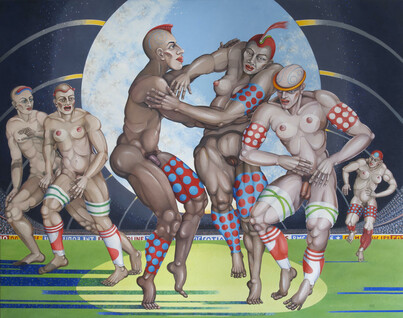
That last example is the pattern worth watching most closely: veteran, serious artists whose sport-related work was previously over looked precisely because it was about sport are now being re-priced and re-historicised by themarket — a strong signal that the subject itself is being taken more seriously, not just the artists working in spite of it.
A market rally driven only by auction houses would be a pricing story. What makes Art & Sports a genuine curatorial territory is that major public institutions have started building permanent and semi-permanent infrastructure around it.
• Manchester International Festival 2025 staged “Football City, Art United,” co-curated by Hans Ulrich Obrist with footballer Juan Mata, pairing major contemporary artists — Paul Pfeiffer, Rose Wylie, Suzanne Lacy — with current and former professional players.
• Liverpool Biennial 2025 commissioned Cevdet Erek's “Away Terrace (Us and Them),” a large-scale installation recreating football-stadium terrace architecture and acoustics — sport treated as a serious subject for one of Europe's most respected recurring exhibitions.
• OOF Gallery, a contemporary art gallery devoted entirely to football, now operates permanently inside Tottenham Hotspur Stadium in London — a dedicated commercial gallery embedded inside sporting infrastructure itself.
• The Paris 2024 Cultural Olympiad commissioned seven artists to create official Olympic and Paralympic poster diptychs, with LVMH's luxury houses formally attached to the programme — folding fine art and luxury brand culture directly into the Olympic movement.
• LA28's Cultural Olympiad, unveiled in 2026 ahead of the 2028 Los Angeles Games, is being built citywide around local artists and community institutions, with official art posters and public activations running through the Games.
• Dedicated curatorial infrastructure is also emerging outside the major institutions: the Sport in Art platform runs an annual “Art Grand Slam” open call with international residencies (in partnership with Czech Centres), giving genuinely emerging artists a sport-specific pathway into the market — the channel through which this research identified several of the more independent names on sport-related artists list.
Taken together, these are not marketing exercises attached to sporting events — they are museums, biennials and festivals choosing sport as curatorial subject matter on its own terms. That is the strongest available evidence thatthe category has crossed from novelty into legitimate art-historical territory.
Sport-related art also benefits from a genuinely new buyer base, one that did not necessarily enter collecting through the traditionalgallery-and-art-fair route.
Athletes as collectors — and tastemakers
A growing number of professional athletes collect seriously rather than decoratively. Grant Hill has built a museum-quality collection of African American art (Romare Bearden, Hughie Lee-Smith, Elizabeth Catlett). Amar'e Stoudemire, a six-time NBA All-Star, collects Basquiat, Rob Pruitt and Hebru Brantley, and curated a basketball-themed exhibition with Sotheby's during 2018 NBA All-Star Weekend. David Beckham has assembled a contemporary British art collection reportedly worth around £30 million, built around a long relationship with White Cube. These are not passive endorsements — several actively curate, lend institutional credibility, and pull their own fan and follower base toward contemporary art in the process.
A demographic handover
Millennial and Gen Z buyers now make up roughly three-quarters of the active collector base, and their habits differ meaningfully from prior generations: 51% of high-net-worth individuals bought at least one digital artwork in 2024/25, and Gen Z collectors put an outsized share of spend —averaging 56% — into adjacent lifestyle collectibles such as sneakers, alongside fine art. Ninety-four percent of wealthy Gen Z and Millennial investors say they are interested in collectibles more broadly. For a category like Art & Sports, which sits naturally at the intersection of fine art, fashion, sneaker culture and fandom, this is a structurally favourable buyer profile rather than a coincidental one.
Brand culture is validating the crossover
Nike's collaboration with Anne Imhof — the German artist who won the Golden Lion at the 2017 Venice Biennale — to reinterpret its Total 90 football jersey line is a useful marker: a Venice Biennale-calibre conceptual artist working directly inside a mass sportswear brand, treated by both sides as a serious creative partnership rather than a licensingexercise. Nike's ongoing seasonal Artist Collection follows the same logic onthe fashion side.
The strongest structural tailwind for this theme may not be the artmarket at all, but the hospitality and wellness economy that increasingly commissions work like it. The Global Wellness Institute forecasts the wellness economy will reach $8.5 trillion by 2027, with wellness-oriented real estate alone approaching $1.1 trillion by 2029 — and hotel groups are responding by building sport and movement into both programming and permanent art collections. Kerzner International's SIRO concept is built entirely aroundathletic performance and recovery; Accor's MGallery Creekside property in Dubai commissioned 482 artworks from 52 artists specifically to support a luxury-sport-and-wellness positioning.
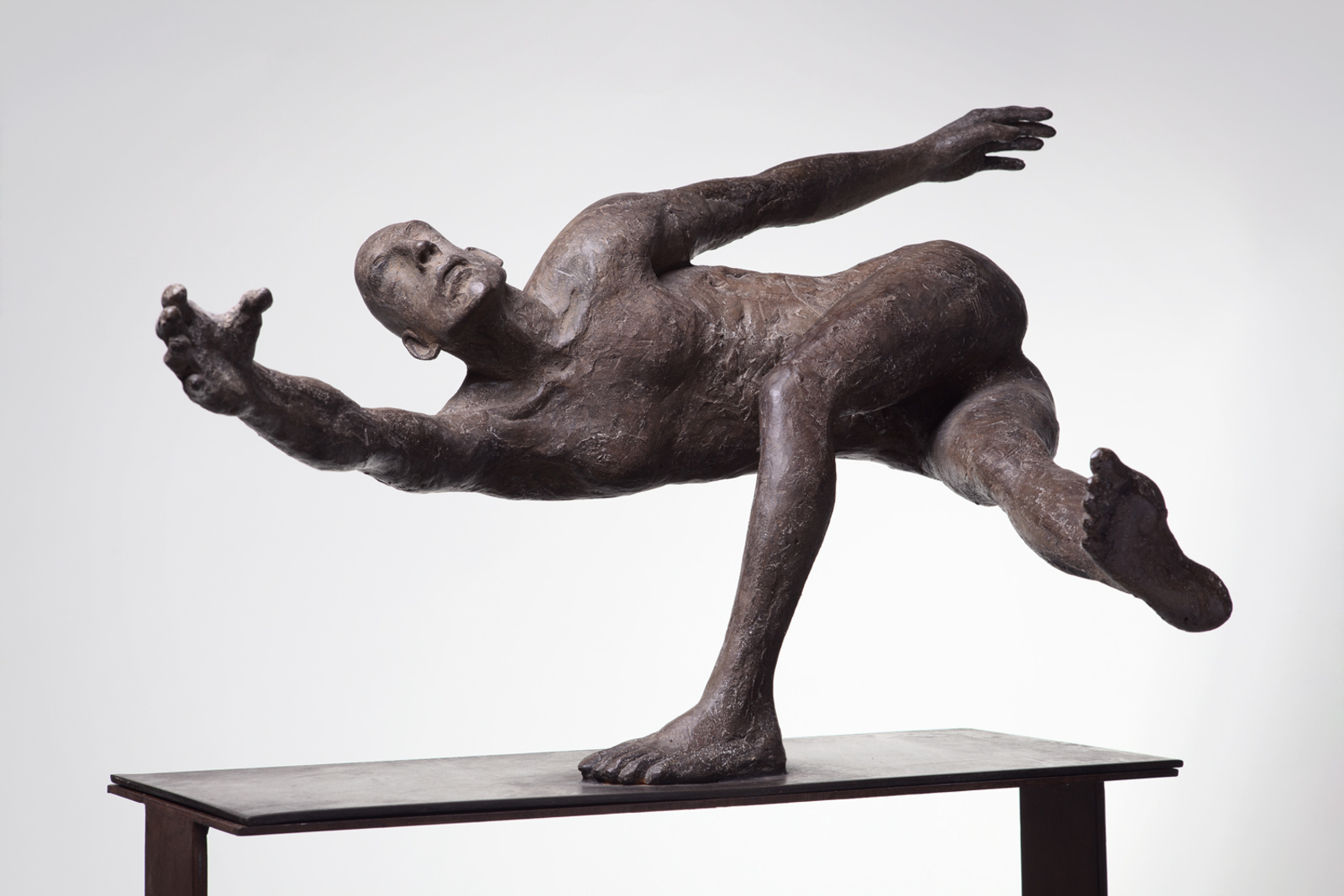
This matters commercially because it creates a buyer for sport-related art who is not a traditional private collector at all: hospitality groups, wellness developers and architecture-led residential projects, who are actively seeking work that “communicates movement subtly” and “integrates naturally into architecture” rather than literal sporting imagery. This is precisely the register occupied by several artists like Guillermo Kuitca's dissolved stadium-diagram paintings, Marta Moreu's weightless dynamic bronzes,or Cevdet Erek's terrace-inspired wall sculptures would sit as comfortably in awellness-hotel lobby as in a museum.
Set against this market backdrop, the artist roster assembled for ArtsBouquet's Art & Sports theme was deliberately built as a spectrum rather than a single style, and that spectrum maps directly onto where the market's real growth is concentrated:
• Figurative/ commercial sport portraiture (Edgar J. Brown, Mark Trubisky, Malcolm Farley, Richard MacDonald) — the licensed, collector-friendly end of the market, closest to the memorabilia boom described in Section II.
• Conceptual and institutional practice (Christian Jankowski, Erwin Wurm, Jeremy Deller, Cevdet Erek, Maider López) — the register being actively commissioned by biennials, festivals and Olympic platforms described in Section III.
• Gestural and abstract movement (Carlos León, Guillermo Kuitca, Marta Moreu, Pablo Azul,Miguel Valverde) — work that translates competitiveness and physical action into a visual language sophisticated enough for architecture-led, wellness and hospitality buyers described in Section V.
The Art Basel &UBS data point on rising demand for photography and documentary-adjacent work, combined with ArtsBouquet's own earlier finding that the strongest sport-related pieces “avoid cliché” and “maintain artistic seriousness,” both argue for weighting curatorial attention toward the secondand third groups — while keeping the first as an accessible, higher-volume entry point for newer collectors.
Three caveats are worth stating plainly, in keeping with ArtsBouquet's position as a serious rather than purely promotional platform:
• Memorabilia is not the same market as fine art. Sotheby's trading-card and sneaker sales are real and growing, but they are a distinct asset class from artist-driven work, with different collector psychology and liquidity. Conflating the two overstates how deep the fine-art buyer pool for sport subject matter actually is.
• Pricing remains genuinely opaque outside the auction-recorded names. The majority of artists researched for this theme — including several of the most critically respected — do not publish prices and sell primarily through galleries on request; average-price figures used in ArtsBouquet's own research file are therefore directional estimates for most of the roster, not quoted transactions.
• The category still carries a decorative-cliché risk. The same market forces pulling serious institutions toward sport (Section III) are also flooding the lower end of the market with generic, licensed sport imagery. ArtsBouquet's curatorial value lies specifically in distinguishing the two — which is the discipline applied throughout the artist-research process behind this theme.
Art & Sports is no longer a question of whether the market exists — the auction data, the biennial commissions, the Olympic platforms and the wellness-hospitality economy all confirm that it does, and that it is expanding faster than the art market overall. The remaining question, and the one ArtsBouquet is positioned to answer, is which artists translate competitiveness, movement and the human body into work serious enough toout last the current wave of interest.
ArtsBouquet's role is to keep making that distinction visible: to hold the licensed portrait, the biennial commission and the gestural abstraction inthe same frame, and to help collectors move confidently between them.

Sources & References
Art Basel & UBS,“The Art Basel and UBS Global Art Market Report 2026” and “Survey of GlobalCollecting 2025,” Arts Economics — theartmarket.artbasel.com / ubs.com
The Art Newspaper,“Christie's and Sotheby's end 2025 with increased sales, thanks to luxurygoods, trophy lots and private deals,” Dec 2025
Artnet News,“Christie's, Sotheby's Report Increases in Annual Sales,” 2025; ArtNews,“Sotheby's Projects $7B for 2025”
Sports CollectorsDigest, “Michael Jordan takes his place next to Monet and Picasso as Sotheby'smakes its mark in sports memorabilia”
Frieze, “WhyContemporary Art Loves Football” (Juliet Jacques, Sept 2025); “The Art WorldFinally Wakes Up to Caroline Coon”
Liverpool Biennial 2025and Manchester International Festival 2025 press materials; OOF Gallery(oofgallery.com)
Olympics.com, “Paris2024 unveils artistic posters as vibrant Cultural Olympiad programme revealed”;LA28.org Cultural Olympiad newsroom, 2026
Sport in Art(sportin.art) — Art Grand Slam open call and artist platform
Artsy Editorial, “Amar'eStoudemire Is Igniting a Fast Break for Emerging Art in the NBA”; “FiveFootballers Who Love Contemporary Art”; Larry's List, “11 Sport-Star Collectorsand What They Collect”
ArtNews, “Anne ImhofBrings 'Doom' Rivalries to Nike's Total 90 Jerseys”; Nike newsroom, ArtistCollection releases
Global WellnessInstitute, wellness economy forecasts; Hospitality Design, “Beyond Relaxation:Hospitality's Wellness Revolution”; Travel And Tour World, MGallery CreeksideDubai
Auction, gallery andpress data for individual artists (Anna Park, Alvin Armstrong, RichardMacDonald, Caroline Coon) as compiled in ArtsBouquet's Art & Sports artistresearch file, July 2026.