Sport has never existed solely within the boundaries of competition. Across civilizations, athletic movement has reflected broader ideas surrounding beauty, ritual, discipline, aspiration, performance, social identity, leisure, architecture and the evolving understanding of the human body itself.
The history of sports-related art therefore cannot be reduced to representations of athletes or games. Rather, it reveals how societies have understood movement, physicality and human potential through changing artistic languages.
From the sculptural perfection of Ancient Greece to contemporary performative abstraction, the dialogue between art and sport mirrors the evolution of civilization itself. This curatorial study developed for ArtsBouquet examines Art & Sports not as a decorative niche, but as a sophisticated cultural territory situated at the intersection of movement, embodiment, architecture, psychology, luxury culture, performance, emotional identity, contemporary collecting, and Mediterranean lifestyle culture.
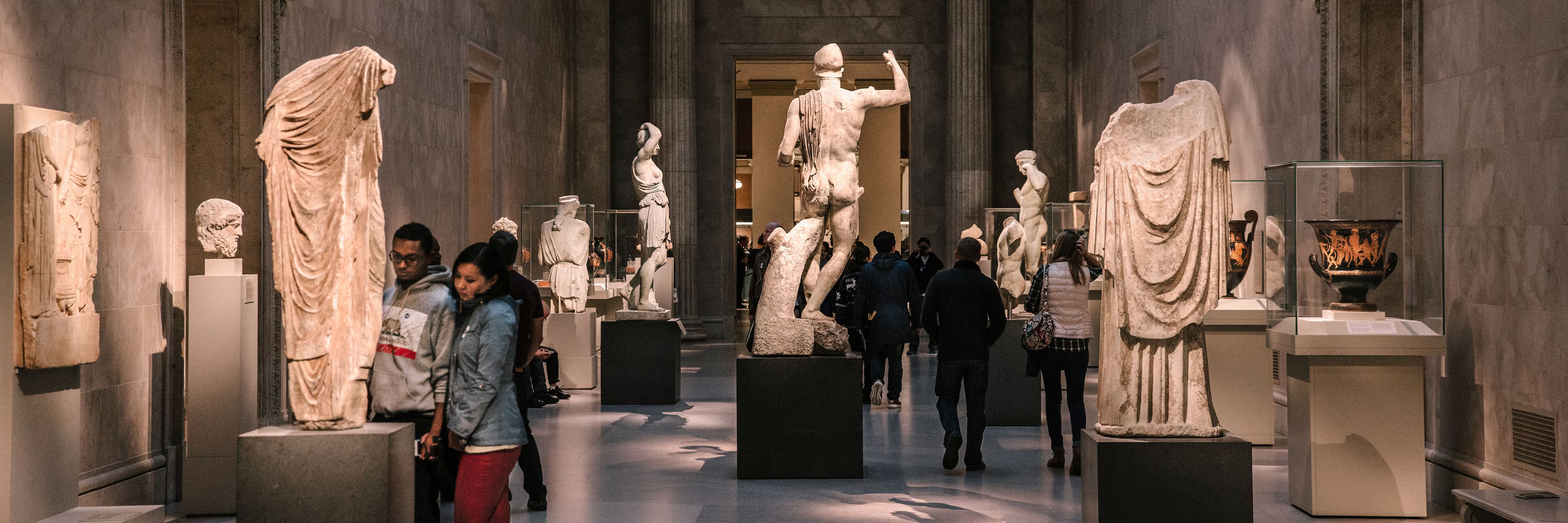
Ancient Greek civilization established one of the earliest and most influential relationships between athleticism and artistic representation. Athletic competitions such as the Olympic Games were not viewed merely as entertainment, but as expressions of harmony, civic virtue, discipline and human excellence.
The athlete became the visual embodiment of ideal proportion and spiritual balance. Greek sculptors developed extraordinary anatomical precision in order to represent muscular tension, latent movement and bodily equilibrium.
The body itself became architecture. The key artistic characteristics were:
• Contrapposto and dynamic balance
• Idealized anatomy
• Frozen movement and restrained energy
• Heroic physicality and divine symbolism
In Antiquity, sport represented civilization’s attempt to idealize human potential. The athletic body became philosophical, architectural and almost sacred.
The Renaissance transformed the representation of movement through scientific observation and humanist philosophy. Artists increasingly studied anatomy, biomechanics and bodily proportion through direct investigation.
The body was no longer merely symbolic. It became measurable, observable and intellectually understood.
Artists such as Leonardo da Vinci and Michelangelo elevated bodily movement into a field of scientific and artistic mastery. The key artistic characteristics were:
• Anatomical precision
• Humanist realism
• Dynamic spatial composition
• Intellectualized physicality
The Renaissance shifted athletic representation from symbolic perfection toward psychological and anatomical realism, laying the foundations for modern representations of sport and movement.
Industrialization radically transformed leisure culture and the social role of sport. Urban societies developed organized sporting activities such as rowing, horse racing, cycling and tennis. Artists increasingly represented ordinary people participating in modern recreational life rather than heroic mythological athletes.
Artists increasingly represented ordinary people participating in modern recreational life rather than heroic mythological athletes.
Sport became connected to modernity, bourgeois leisure, public identity, and urban rhythm.
The key artistic characteristics were:
• Impressionist movement and fluid brushwork
• Outdoor light and atmospheric environments
• Informal bodily movement
• Psychological realism
The key artists & references were:
• Edgar Degas — dancers and disciplined bodily repetition
• Thomas Eakins — rowing and boxing scenes
• Édouard Manet — leisure culture and modern spectatorship
So, the nineteenth century transformed sport from ritualized heroism into social culture and public spectacle.
The early twentieth century introduced unprecedented acceleration through automobiles, mechanization, industrialization and mass spectatorship.
Sport became intertwined with speed, energy and technological progress. Artists no longer wished merely to represent movement — they attempted to visually recreate the sensation of movement itself.
The key artistic characteristics were:
• Fragmentation and sequential forms
• Dynamic composition
• Velocity and acceleration
• Mechanical aesthetics and energetic propulsion
Some of the key artists and references were:
• Umberto Boccioni —Unique Forms of Continuity in Space
• Giacomo Balla — Dynamism of a Dog on a Leash
• Marcel Duchamp — Nude Descending a Staircase
In a nutshell, futurism transformed the athletic body into a symbol of modern civilization, technological acceleration and industrial energy.

Following World WarII, artistic practice increasingly emphasized gesture, spontaneity, enduranceand bodily engagement.
The act of painting itself became performative.
Painted by Kazuo Shiraga.
Movement was no longer simply represented — it generated the artwork itself.
The key artistic characteristics were:
• Gestural abstraction
• Action painting
• Physical process
• Immersive scale
• Performative mark-making
Some of the key artists & references were:
• Jackson Pollock — action painting
• Kazuo Shiraga — foot-painting and bodily performance
• Yves Klein — performative artistic practices
In our curatorial interpretation, post-war abstraction dissolved the boundaries between athlete, performer and artist. The body became simultaneously medium, tool and subject.
Today, sport intersects with architecture, luxury culture, wellness, fashion, celebrity, hospitality, and aspirational lifestyle culture.
Contemporary artists increasingly engage with performance psychology, ritual, endurance, emotional pressure, fandom, and collective identity.
Contemporary sports-related art no longer belongs to a single visual category. It has expanded across conceptual art, photography, gestural abstraction, installation, mixed media, and interdisciplinary practices. The key artistic characteristics are:
• Kinetic abstraction
• Material experimentation
• Emotional and psychological narratives
• Architectural compatibility
• Minimalist spatial aesthetics
Some of the key artists & references are:
• Marco Adamo —gestural sports abstraction
• LeRoy Neiman — sports spectacle and cultural imagery
• Julie Mehretu — layered velocity and spatial movement
• And contemporary sailing, golf and tennis-inspired artists
In summary, the contemporary art & sports increasingly explores not merely competition, but broader themes surrounding identity, aspiration, pressure, ritual and emotional performance.